
Green Products and Innovation
Green Product (Clean Technology) Design and Management
USI is committed to promoting green practices and fostering harmonious coexistence between environmental sustainability and social development. To ensure compliance with international green product regulations and customer requirements, USI maintains effective communication channels with suppliers and customers throughout the entire product lifecycle. From raw material sourcing to after-sales services, the Company implements a series of preventive green management measures to minimize the environmental impacts of its products and manufacturing processes, while continuously enhancing sustainable value creation.

USI has five product categories: Wireless Communication, Cloud & Storage, Industrial & Medical, Consumer, and Car Electronics. Electronic products have developed towards light, thin, short, low power consumption, interconnected, and intelligent learning. In addition, due to the significant increase in the bandwidth of 5G networks, the development of networks and smart devices has been promoted. Digitize the information of things and things, and form a large-scale connection network through reading, transmission, and processing, which is used in logistics and transportation, industrial manufacturing, health care, smart environment, and urban facilities.
We use 5G laboratory measurement verification, provides the best miniaturized antenna design for smart mobile devices, and promotes electronic products for computers, communication electronics, wearable electronics, industrial electronics, electric vehicles, and links to cloud server data Storage and computing, integrate all product technologies to form an Internet of Things network, and develop market opportunities with low consumption and low pollution with clean technology to meet customer product needs.
In accordance with international regulations, customer requirements and environmental protection trends, Company conducts comprehensive, systematic, and transparent management and control of product design, material procurement, product manufacturing, transportation, packaging, sales and recycling every year to achieve the reduction and exemption of hazardous substances free (HSF) goal. And formulated our “Green Products Policy and Design Principles” to guide the development of environmentally responsible products. The Company is committed to developing products with lower pollution, reduced resource consumption, and lower carbon emissions, while providing customers with enhanced product design and manufacturing services. For related investments and performance achievements, please refer to the “Sustainable Product or Service Investments.”
We follow the IECQ QC 080000 Hazardous Substance Process Management System Standard and establish comprehensive control procedures for green parts and materials to ensure compliance with international regulations and customer requirements regarding restricted hazardous substances. USI’s suppliers must confirm all provided components, non-BOM and packaging materials comply with applicable regulatory requirements and substance control standards. Suppliers are required to submit relevant compliance information through the “Green Product Assurance Reporting System (GPARS)” or Questionnaire methods. For detailed management requirements, please refer to the “Hazardous Substance Management” and “Partial Selection of Restricted Environmentally Hazardous Substances Contained in Products.”
Hazardous Substance Risk Assessment Process
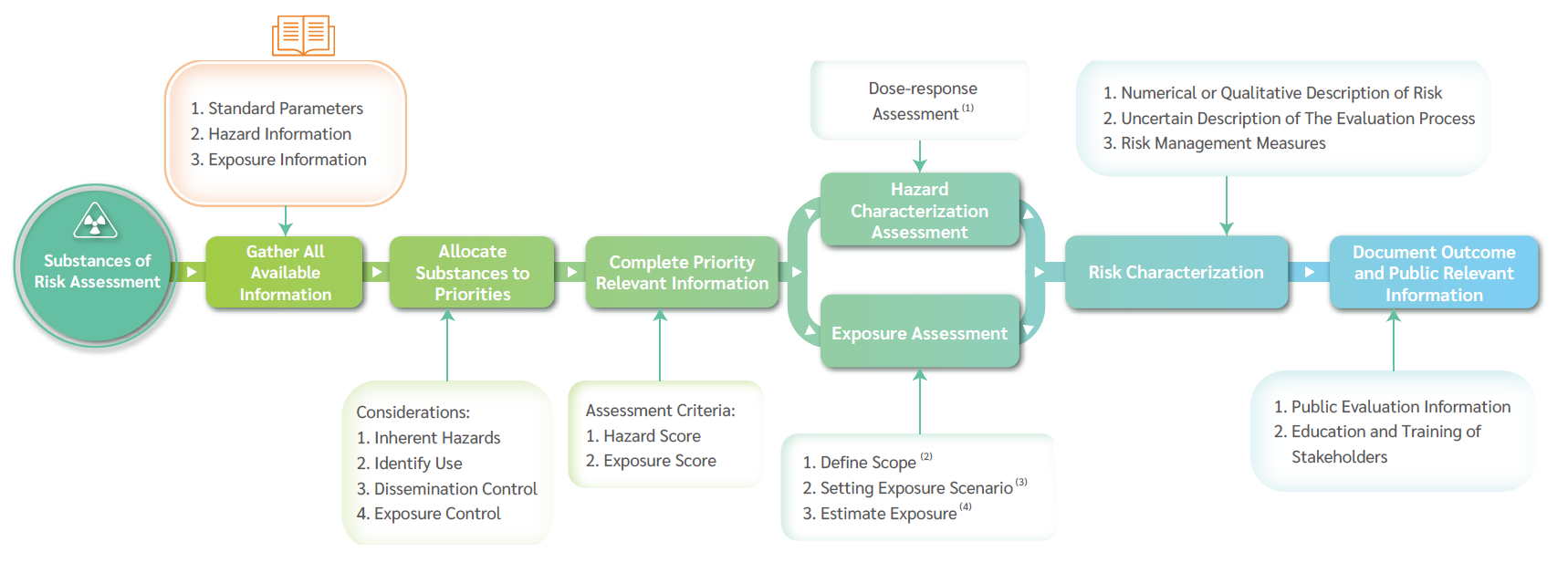
USI's Hazardous Substance Risk Assessment Process includes the management of hazardous substances in products and chemicals used in production. We evaluate hazardous substance risks and opportunities based on frequency of occurrence, frequency of exposure, and degree/severity of impact, and the higher the risk multiplier score, the higher the risk level. The Company uses the risk level identification to propose countermeasures to reduce the potential impacts on human health and the environment.
Risk Assessment Process
Note:
1. Dose-response assessment include the human health hazard, physicochemical hazard, environmental hazard, persistent, bioaccumulative and toxic (PBT) and very persistent and very bioaccumulative (vPvB).
2. Define scope include the material manufacturing, use and exposure information.
3. Setting exposure scenario include the used scope, usage, possible exposure routes and exposure control measures.
4. Estimate exposure include the worker exposure/concentration or environmental exposure concentration.
Chemical Safety Management Process
To mitigate potential safety and environmental risks arising from the use of chemicals, USI has established a comprehensive Chemical Control List that defines substances prohibited from use within its operations. By implementing rigorous upstream chemical management and source control measures, USI proactively reduces chemical-related risks and reinforces its commitment to workplace safety, environmental protection, and regulatory compliance.
Chemical Safety Management Process
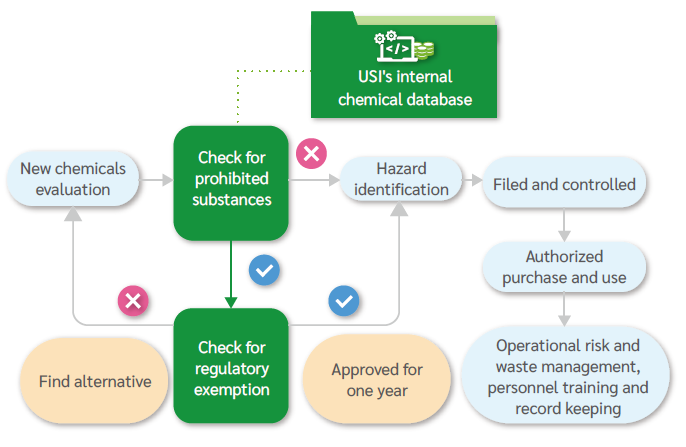
For relevant restricted substance management performance and investments in hazardous substance substitution and elimination, please refer to the attached file:

USIs R&D personnel have ecological design capabilities and continues to implement green concepts and clean technology into their projects, which allows us to sell environmentally friendly products around the world.
Promoting Green Design
A green product with clean technology needs to comply with two or more green products ecological design standards to improve energy efficiency and reduce environmental pollution. In 2025, revenue from cleaning-related technologies accounted for 55.71% of the overall revenue of the Company. In the future, we will continue to invest in green product research and development and increase the proportion of green products.
| Green Product Category | Percentage of Revenue in 2025 |
|---|---|
| Communication Products | 26.82% |
| Industrial & Automobile Electronic Products | 1.60% |
| Consumer Electronics & Cloud and Storage Products | 27.30% |
| Total | 55.71% |
The following is the individual performance of ecological design products over the years:
| Product Revenue Ratio | 2022 | 2023 | 2024 | 2025 |
|---|---|---|---|---|
| Energy Efficiency | 11.2% | 2.5% | 2.5% | 2.0% |
| Electronic Waste Recycling | 13.2% | 11.9% | 9.7% | 11.8% |
| Light and Compact | 58.0% | 67.0% | 67.8% | 67.1% |
| The Proportion of Total Revenue | 82.4% | 81.4% | 80.0% | 80.9% |
In our product energy saving evaluation, USI's eco-design products saved 58.7 GWh (about 211,353 GJ), equivalent to reducing 23,716 metric tonnes of CO2.
We encourage a green and innovative corporate culture and facilitate green design proposals. USI's green products were designed based on its green product design principles and green promise, the results of green-related design are as follows:
Product Compliance Aspect
We stringently control the use of raw materials for our products and use low-pollution and non-toxic raw materials to ensure that our products comply with the relevant regulations and directives. Furthermore, we conduct product lifecycle inventory and eco-design evaluations, and publish product eco-characteristics manual to comply with the EU ErP Directives.
To protect users, all facilities apply the Factory Inspection Mechanism to ensure product safety and compliance with relevant laws, regulations, and ordinances internationally and where they are sold. In 2025, we received zero complaints about products endangering human health and safety, and no product safety-related violations were found.
For relevant product compliance performance, please refer to the attached file:
Eco Labels Aspect
SDG 12, Responsible Consumption and Production, calls on countries and industries to promote circular economy models by optimizing material use and enhancing resource circulation. This approach encourages green product design focused on durability, repairability, and recyclability, enabling resources to remain within a closed-loop supply chain and maximizing their value throughout the product lifecycle. By incorporating life cycle assessment (LCA) principles and advancing green economic development, organizations can contribute to more sustainable patterns of consumption and production.
Eco-labels help consumers identify products and services that demonstrate environmental performance beyond regulatory requirements. As such, eco-labeling is recognized as one of the effective approaches to supporting circular economy practices and promoting sustainable consumption.
For relevant eco labels performance, please refer to the attached file:
Investigate the carbon emissions of products from raw material acquisition, manufacturing, use and disposal in a life cycle manner, and converted into the sum of carbon dioxide equivalents.
Since 2017, USI has continued to review the carbon footprint data of a major product every year and verified it through a third-party or self-inventory to disclose the performance of greenhouse gas reduction, and further identify the key factors of carbon emissions through the report results to achieve the reduction purpose.
PCF Inventory Performances in 2025
| Product Category | Product Name | Emissions (kg CO2e/pcs) |
Certificate / Inventory Report |
|---|---|---|---|
| Industrial, Automobile Electronic | Audio Amplifier | 206.72 | |
| Cloud and Storage | Server Mainboard | 5.78 | |
| Industrial, Automobile Electronic | Mobile Computer | 14.63 | |
| Cloud and Storage | HZ_Smart Dock | 87.60 | |
| Cloud and Storage | HPH Smart Dock | 80.90 | |